the court palace

On 1st September 1476 Ercole I d'Este was out of town.

His nephew Nicolò, Leonello's son, took advantage of his absence and invaded with a large group of armed townsfolk. He took possession of the piazza under the insignia of the "sail" erected against his uncle's insignia the "diamond".

The duchess Eleonora of Aragon, who energetically helped her husband in the running of the city during his long and frequent trips away, fled from the palace apartments with her children towards the safety of the Castello di San Michele. To do this she crossed the bridge that just a few years before had been converted into a solid gallery protected from prying eyes and inclement weather and which from that time on became known as the Via Coperta.

The people of Ferrara failed to help the invaders who were pushed back, captured and executed. Three days later, Nicolò himself was beheaded in Santa Caterina Tower.

The episode was rather significant inasmuch that it certainly contributed in no uncertain terms to the Duke's decision to move their residence once and for all to within the safety of the castle walls.

From that moment on the fortress slowly began, through a series of long, never-ending works, to change into a residence worthy of housing the apartments of dukes and duchesses, commissioned at first to the court engineer Pietro Benvenuti degli Ordini. He extended and transformed entire wings of the fortress and built in living spaces.

Decorative improvements had already begun to appear under Borso.

During those years the castle began to display decorations above all on the outside between the Marchesana Tower and the Torre dei Leoni, towards the street that led from Porta del Leone to Piazza del Mercato.

THE CASTLE UNDER ERCOLE I

With Ercole and Eleonora a lot of new decoration was done, both on the inside and the outside, but more than anything else important extensions and changes were made along the side that goes from the old palace to the rooms near the Torre dei Leoni.

Obviously, they tried to change the austere rooms of the fortress into welcoming apartments and to create an area on the first floor (piano nobile) that was similar to their palace without interfering with the ground floor, that of the courtyard, where important functions aimed purely at the defence of the family's new castle home were still concentrated.

The Via Coperta, the Duke's new apartment, was extended, extensively decorated on the outside with frescoes, statues, and fake architectural features.

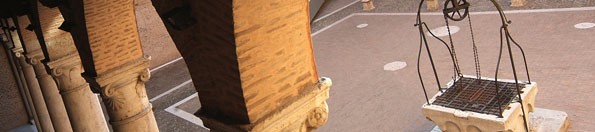
The eastern wing of the castle doubled in size and at the same time the courtyard was changed and a new portico added. It was perhaps just at this time, when the courtyard became a courtyard of honour that the stables and many of the service workshops were moved into the large yards that surrounded the castle. These sheltered under a primitive gallery which stood against the four sides of the castle, held up by large square pilasters.

In 1483 Duke Ercole was helped in his work by Biagio Rossetti, the new court architect and the two brought into being a magic period in the city's development of architecture and town planning, which in the space of just a few years saw the city walls more than double in length and construction sites for streets, squares, palaces, churches and convents spring up everywhere.

The effects were also felt in the castle, which came to find itself at the centre of the city. Among the castles that history has conserved it is very rare to see one with such a central urban position.

They have usually remained separated from the urban fabric, perched on high and in any case still evidently ready to assume the original function of defending the suburb of the city in a direct confrontation with potential enemy.

Ferrara's Castello Estense, right at the centre of the town clearly remains a defensive building but also becomes an austere generating presence that radiates over the city through glimpses that lead to the castle no longer only dominating the panorama of the surrounding countryside but appearing in glimpses from the ends of the many roads that from the older and newer gateways lead to the centre.

At that time decoration work was concentrated on Eleonora's apartment, which was near the Marchesana Tower towards the Torre dei Leoni, and it was Rossetti himself, in that part of the castle who began the construction of the Giardino degli Aranci (Orange Garden) and the building of the new Ducal Kitchens.

go back

THE CASTLE UNDER ALFONSO I

Ercole died in 1505 and was succeeded by his son Alfonso I who continued the renovation work on the castle-palace undertaken by his father and supported by the court architect Biagio Rossetti.

Besides modernising the apartment that had belonged to the Duchess Eleonora for his wives, firstly Anna Sforza and then Lucrezia Borgia, the duke built other wings and rooms in the castle to house a grocery store and a goldsmith's workshop and also an armoury (various rooms for housing arms and munitions). This was one of his great passions; he was an expert in the design and casting of cannons.

Alfonso completed the great Ducal Kitchens, built on the foundations of the demolished Porta del Leone and the East Gatehouse below the Giardino degli Aranci and more than anything else he modernised and extended for himself the apartment-study that had belonged to his father on the Via Coperta. And so that small but precious residential quarter came into being. It consisted of a sequence of rooms, known as the Golden Study or Alabaster Study and into it flowed an extremely important collection of the artistic talents of the day.

A real decorative blueprint created with the help of the greatest artists of that time, from Ferrara and elsewhere, such as for example Titian, the Dossi brothers, Antonio Lombardi, Raffaello Sanzio, Giovanni Bellini and others.

go back

THE CASTLE UNDER ERCOLE II

Ercole II, the son of Alfonso I and Lucrezia Borgia, continued the work of improving the castle, which bore the strong signs of his father, with refinement and sensibility.

he had several rooms decorated with paintings and frescoes, both to complete the decorative cycles set out by Alfonso and also to his own original ideas. The chief artists involved were Tommaso da Carpi, Battista Dossi, Tommaso da Treviso, il Garofalo, Camillo Filippi and Girolamo da Carpi.

In particular, Ercole II turned his attention to sectors of the building dedicated to a new high-ranking residential and representative function, the rooms of the south wing, in particular the Salone del Governo (Government Room) and the apartment of Santa Caterina Tower, which became the object of a decorative cycle which was hinged on the so-called Camera della Pazienza with excellent works by Camillo Filippi and Girolamo da Carpi.

In 1554, a big fire caused serious damage to the more than half of the castle, especially the top floors from the Marchesana Tower to the Torre dei Leoni and Santa Caterina Tower. The event induced the duke and his court architect to intervene not only to simply rebuild the upper floors and the lost or damaged roofs but also to make changes to the architectural appearance of the castle. So, given that the rooms of the piano nobile were already turned over to residential use, he went ahead with a complete redesign of the building's exterior and changed its style into something we may consider to be very close to the monument's current appearance.  

go back

THE CASTLE UNDER ALFONSO II

The work that revolutionized the appearance of the monument was completed in a respectable manner, after Girolamo's sudden death, by Alberto Schiatti, who handled the repairs needed after the disastrous earthquake that struck Ferrara and its castle in 1570. In the meantime Alfonso II became duke.

Both the fire and the earthquake left a lot to be sorted out in the apartments on the piano nobile. The new owner, son of Ercole and the duchess Renée of France, got to work immediately on the enormous task of redecorating.

The many large rooms, along with those of the new second floor destined not to become living quarters but mostly to accommodate the increasingly complex administrative apparatus of the territory, were extensively renovated (of note the works in the Camerini Dorati [Golden Study] and in the Sala del Governo [Government Room]) . Everywhere the damage done due to the disasters or to other events had meant restoration of some degree was necessary.

With the intention of giving prestige to the Estense residence in the eyes of the duke, the court and the world, Alfonso decided to call upon the architect Pirro Ligorio, who had proved his worth to the family working on the Villa d'Este at Tivoli near Rome for Cardinal Ippolito. Thanks to a specific high-level plan concerning decoration and content, the result of the artistic enrichment was orderly and distinguished.

At that time painters such as Girolamo Bonaccioli, Ludovico Settevecchi, Leonardo da Brescia and Sebastiano Filippi, known as Bastianino worked in the castle.

Pictures and sculptures were purchased for the Antiquarium; the Apartments, the Studies and the Galleries were reorganised; the Appartmento dello Specchio (Mirror Apartment) was frescoed; the Cappella Ducale (Ducal Chapel) was decorated and the courtyard was given a Renaissance decorative appearance.

go back